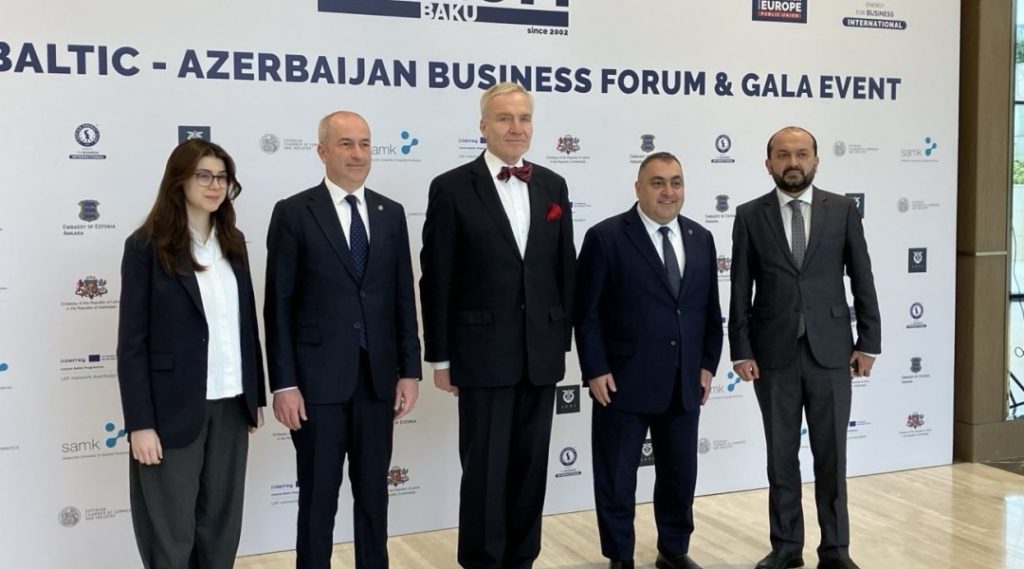
In October, Estonian Minister of Foreign Affairs Margus Tsahkna visited Azerbaijan together with an Estonian business delegation to strengthen economic and digital cooperation between the two countries. The delegation included 15 companies from various sectors, and meetings with İlham Əliyev and Ceyhun Bayramov were also on the agenda.
According to Minister Tsahkna, several Estonian companies have been successfully operating in Azerbaijan for years and have contributed to the development of the country’s e-governance solutions. “Many members of our business delegation already have ongoing cooperation projects in Azerbaijan. Our goal is to strengthen and expand this – alongside digital services, transport and logistics, there are opportunities in many other sectors as well,” Tsahkna said.
One of the companies participating in the visit, B.EST Solutions, has been operating in the Azerbaijani market for over 15 years, helping to develop and manage the Asan Imza mobile digital identity and e-signature infrastructure, which is one of the cornerstones of Azerbaijan’s digital state. The company’s founder and CEO, Jana Krimpe, noted that it is now integrated with more than 2,000 e-services, including all banks and government platforms.
“Asan Imza is one of the foundational elements of Azerbaijan’s digital state. The solution enables citizens and businesses to use secure e-services regardless of time and location,” Krimpe said.
According to her, the aim of the visit was to strengthen the strategic partnership in digital cooperation between Estonia and Azerbaijan and to represent Estonia’s private sector, which has long-standing experience in developing e-government solutions. “It was an excellent opportunity to discuss new directions in innovation, cybersecurity, and cross-border digital identity, where Estonia is a recognized pioneer,” Krimpe added.
“When it comes to areas such as digital government development or data protection, the support of the Estonian state and diplomatic presence is particularly important – it gives our companies greater visibility and credibility in international markets,” Krimpe emphasized.
Fleetguru, a company developing fleet management software, is also planning to enter the Azerbaijani market. According to Sven Aulik, Director of Partnerships at the company, they signed a cooperation agreement during the visit with their first partner who will represent them in the market.
“There are still relatively few service providers like us in the Azerbaijani market, and as digitalization is also a hot topic in the region, we see strong potential there. Our longer-term goal is to expand across the Caucasus and possibly into Türkiye,” Aulik said.
According to him, state-led business delegations make it possible to meet multiple potential clients and partners at once. It was also important that representatives of the Estonian state were always ready to engage in detail with companies’ needs. “This is especially important in countries where decision-making processes are hierarchical and often intertwined with the public sector. Without state support and the backing of local policymakers, it may not be possible to even get through the door of larger companies,” the Fleetguru representative explained.
To support Estonian companies in finding business opportunities, a joint business forum involving Estonia, Latvia, Finland, and Azerbaijan was also held in Baku on 21 October. The programme for the business delegation was organized by the Ministry of Foreign Affairs in cooperation with the Estonian Chamber of Commerce and Industry. In addition to B.EST Solutions and Fleetguru, the delegation included Prolog, DEEEBOX, SLD Consult, Live Technologies, Skines Rail, SAL Recruitment, Systemseparation, CV Partner, Intraglobe, KKT Production Group, TBE Sales, Primewood, and NV Trade. The education sector was represented by Järvamaa Vocational Education Centre and TalTech.